 Анна Шиман
Draft translation. This text was translated automatically and has not been proofread yet — if something reads oddly, it does.
Ancestral memory, family systems and ancestral scripts. Psychological states.
Genetic memory (gene memory, racial memory, ancestral memory, hereditary memory, biological memory) is the set of hereditary reactions passed on to an individual across generations through genes.
According to Jung’s theory, in human beings genetic memory is the collective unconscious. It is the experience of a person’s ancestors, represented by the nerve structures of the brain. Carl Jung also linked certain mystical shades of meaning (connotations) with the term.
Deep inside every event that happens to a person there is always an original cause. This cause underlies a person’s choices, reactions and behaviour. Often a person does not stop to think that the true cause of what happens to them is hidden within, rather than brought about by outside influence.
Even so, there is no need to load yourself with an excessive responsibility for absolutely every cause, as many of us like to do.
The world of causes is vast; it has its own levels and structure.

The widespread idea that descendants bear responsibility for the deeds and debts of their ancestors leaves few people indifferent. This idea is true, and we will try to explore it from the point of view of psychology.
Yet the ancestors will never learn of this truth, and the descendants may spend a whole lifetime without ever reaching the real causes, which go far back into the past, into the depths of the family line.
Ancestral scripts, stored in the very deep layers of the world’s memory, have their source in archetypal matrices and in the most important, first script of all — the script of original sin.
To work with the memory of the past, you need to build stability of the psyche and of consciousness, and to build self-awareness.
This is what we do on our basic courses in psychology and Tarot.
When feeling sadness, longing, guilt or grief, a person often wants to know their cause.
Have you ever wondered why?
Very often this wish comes not from an intention to change the cause, but from a need to get rid of the painful feelings as quickly as possible, so as not to meet the “bad” self. A person wants to become good and right as soon as possible, to return to their usual state or, as can often be seen, wants to feel only joyful and “good” feelings all the time.
- Do the causes that give rise to negative states stop existing if you pretend they are not there?
- Why look for the cause if you have neither the strength nor the competence to deal with it?
When you open the door to the memory and experience of the past, you need to be ready for absolutely any information and any states.
At the same time, as they go deeper into the causes, a person feels helpless, weak and limited, and is eager to get rid of these sensations as soon as possible.
The urge to understand everything and explain everything often hides an ordinary distrust of oneself and of others.
The urge to control everything and everyone around, to block one’s feelings and experiences, speaks of the same thing. So does self-condemnation, when there is no other way to cope with what simply needs to be lived through and felt.
Suppressing feelings, emotions and states is not transformation; it only puts off unpleasant experiences for a while, and so makes things worse for the one who does not want to live them through.
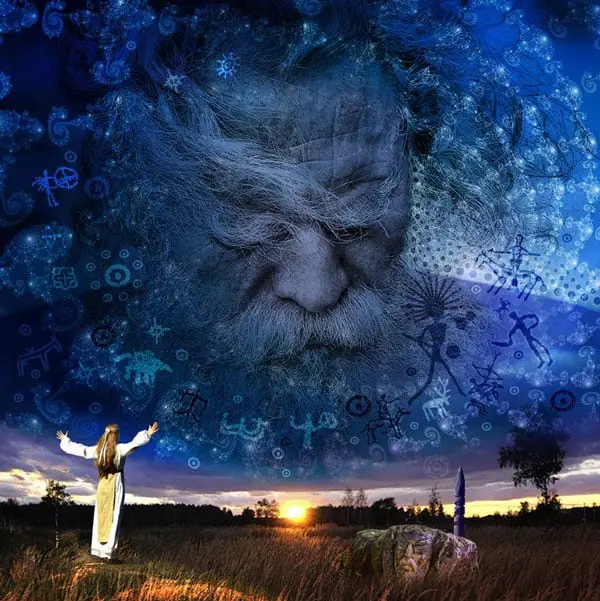
Often there is tension hanging in the air of such a person’s family system, and relationships are built on a codependent pattern.
As we know from physics, energy never disappears; it only changes its quality.
All the psychic energy is held within the family and ancestral system, creating tension between its members. The weaker links of this “ancestral chain”, usually children and the elderly, often suffer because they are forced to “pass through” themselves the feelings the adults have not lived through.
The more sensitive and gentle members of the family system, those prone to merging and empathy, are often forced to play the role of the “scapegoat” or the “family outcast”, giving those who suppress and repress their feelings a way to discharge the tension.
Hence the long lines of drinking, addicted men, the roots of alcoholism or of destructive scripts of self-destruction, of “strong” women and weak children with broken lives.
For example, if a woman has not accepted her father, and her psychic field holds pain, anger and resentment towards him that she has not lived through and turned into a memory, there is a chance she will meet a man with whom to work through this lesson, transform the ancestral energies and discharge the tension. But if the woman does not manage to transform her negative feelings, roles and scripts, there is a chance that her child (often a son) will later become dependent on alcohol or drugs. And while you can divorce a husband and move apart, with a son this is far harder. Is it possible to move away from yourself?
Many try, but the energy finds a way out one way or another — now in the form of heavy obstacles in life, crises, incurable illnesses, destructive situations repeated from generation to generation. This is how the ancestral field works, the ancestral channels that hold absolutely all the experience of a given generation.
The stronger a person’s energy, the higher their vibrations, the firmer their consciousness and will, the less chance they have of becoming a conduit for negative energies, for experience that is not theirs, for other people’s feelings that someone in the family line is still repressing to this day.
Have you ever asked yourself whose feelings you are really living through?
Can you tell “your own” apart from “not your own”?
The cause of such negative states may lie in the distant past. Perhaps in such a person’s childhood there was never the time or the opportunity to learn to come into contact with them, to go through such deep and difficult states, to overcome stress. And then we get anxiety and fear that go as far as panic attacks and compulsive actions.
In such cases a person becomes a hostage to what is happening: to their own reactions, character traits and automatic behaviour. Let us call this dependence a “script” — one that prescribes, obliges and urges you to make the same choices over and over, to react in the same way to different situations and people.
And, by the law of vibrations, to attract into your life situations that call up the same reactions again. Cyclicity is one of the signs that you are inside a script, a programme or an automatism.
To explain the nature of states to yourself by means of reason, you need to command the language of the subconscious — the language of symbols.
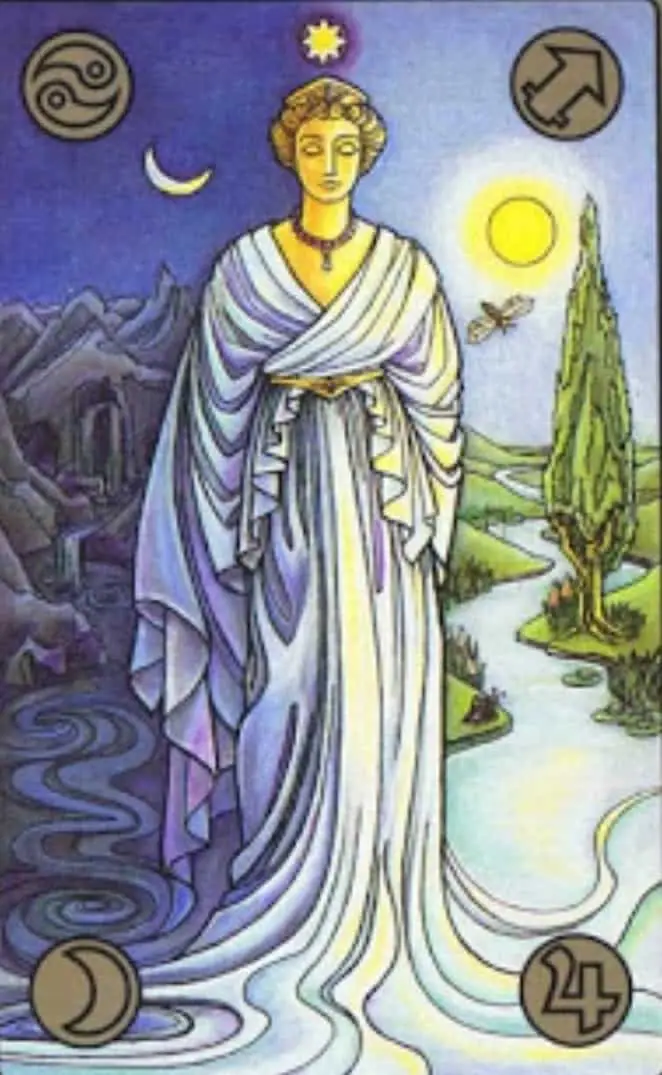
The “Mnemosyne” card, Symbolon deck
Mnemosyne is the goddess of memory. As the myths tell, Mnemosyne was a Titaness — a goddess of the first generation, daughter of Uranus (the sky) and Gaia (the earth). According to the poet Hesiod, Mnemosyne knows “all that was, is and will be”. She is the mother of the nine Muses, born to the sky god Zeus. The Muses are the patronesses of talents, arts and sciences.
To come into contact with the positive energies that are also present in ancestral memory, you need to have similar vibrations yourself.
A systemic approach to personal development helps you not only to learn information but also to build a stable structure of knowledge by putting it into practice.
If a person wants to step out of a script, they should take up self-observation.
The difficulty here lies in separating behaviour driven by the script from behaviour that fits what is happening in reality, here and now. Reacting “from the script”, a person is forced to keep going round in circles, living through the same thing time after time.
If you notice that you:
- are moving in circles;
- react too strongly to people and circumstances;
- take a long time to calm down, store up resentment or negativity;
- repeat the same pattern of behaviour
- attract similar people or circumstances;
- feel unable to manage your reactions or behaviour
it is quite possible that your behaviour is governed by an automatic script.
To step out of a script, you first need to see it and become aware of it. Feelings and states need to be transformed by living through them and engaging with them in your inner world. Then there is a chance to come closer to a wholeness of perception, and so to touch earlier causes in order to transform them.
This is the mechanism by which ancestral messages are transformed and ancestral channels are “cleansed”.
Going deep into the world of causes is a very demanding undertaking that calls for time, strength, energy and an experienced guide. And without knowing how to cope with what rises to the surface, a person may end up in a dangerous and difficult situation that threatens their psychological and physical health.
Getting to know the old causes and scripts that govern your behaviour is what we do in the depth programmes of our centre.
However, to work with causes seriously, you need to build useful habits and self-regulation skills, master the basics of psychology, learn mental hygiene, and strengthen your ego and awareness.
All this — on our courses and programmes!
To see differently is to change reality!
We invite you to do it together with us!
Anna Oleksandrivna Shyman, head of the centre.