The Girl in the Black Funnel

Draft translation. This text was translated automatically and has not been proofread yet — if something reads oddly, it does.

A method of 21 portraits and a bot that walks you through it step by step: from the image of a state to its echo in the body, the defence behind it and writing a fairy-tale ending. 9,261 unique combinations to work with, which is why people come back to the deck for years — in different states and with different questions.

Where it runsTelegram
Freethree random cards — the gallery, the questions and your own answers
With a subscriptionthree levels, permanent, from $17
The Girl in the Black Funnelbot
This is The Girl in the Black Funnel MAC system. Twenty-one portraits — twenty-one states people usually keep out of sight. Shall we pick a card?
Random cardOpen the galleryLevels and prices
GUILT. Stay with this image for a few seconds. Then come four questions, one at a time.
Question 1 of 4. Look at the portrait of the girl. How do her gaze, her posture, her face and the details around her hold Guilt? Describe it in your own words.
She looks away and hides her hands
The immersion story, the Shadow Journal questions and the fairy-tale ending open at levels two and three.
Message
What it looks like

Where the bot lives

The bot lives in Telegram only: no site and no app to install. Access is tied to the account the purchase was made from.

This is a piece of the real script, not a mock-up: the practice itself happens in Telegram — tap the input line.

What this is

The Girl in the Black Funnel MAC system is an original deck of metaphorical cards and an assistant bot that guides you through it. Note that this is not just a set of pictures with fixed meanings but a professional method: each portrait (a projective stimulus) is a shaped image of one particular state, and the bot asks it the questions a psychologist would normally ask in a consultation. You pick a card, the system recognises it and leads you on through the script with questions — what you see in the image, where it echoes in the body, what the psyche is defending, and what this part might turn out to be good for.
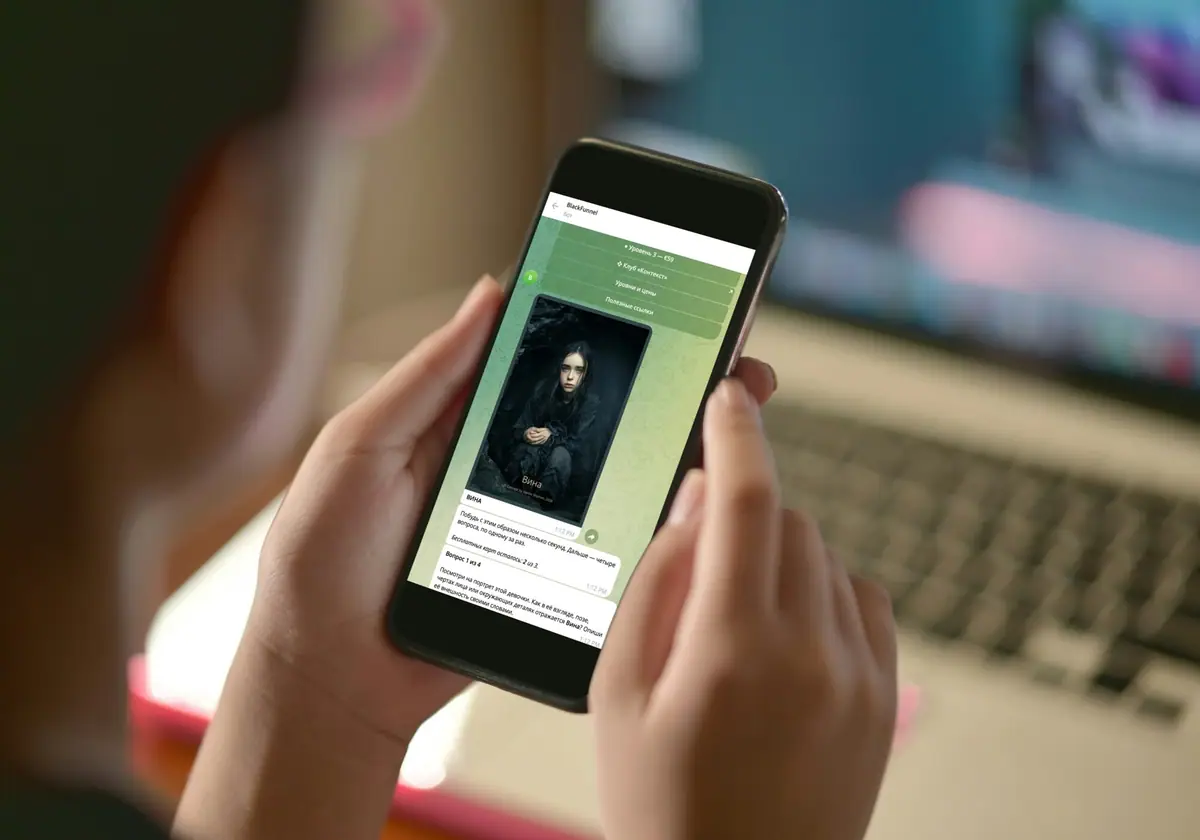
The card “Guilt” and a question about the image in a chat with the bot on a phone screen

The deck was created out of Anna Shyman’s many years of practice and rests on four structural supports: emotional-image work, psychosynthesis, fairy-tale work and symbol drama. Hence the order of things — first the image, then the body, then the defence, and only at the end words and meaning.

What the deck contains

Twenty-one portraits made to the author’s concept. They are split into three blocks, and the split also works as a first assessment: people usually find themselves in one of them.

  • Cards 1–5. The basic wounds and masks (after Lise Bourbeau): rejection (the Runaway), abandonment (the Dependent), humiliation (the Masochist), betrayal (the Controller), injustice (the Rigid).
  • Cards 6–15. Shadow feelings: suppressed rage (the Rebel), envy (the Comparer), arrogance (the Snow Queen), chronic anxiety (the Panicker), guilt (the Eternal Sinner), toxic shame (the Invisible One), helplessness (the Little Girl), self-sacrifice (the Pleaser), greed (the Black Funnel), apathy (the Dead Princess).
  • Cards 16–21. States of deficit and roles: impostor feelings (the Deceiver), immaturity (Puer), sinfulness (the Harlot and the Nun), loneliness (the Hermit), rivalry and aggression (the Huntress), lost identity (the Chameleon).

The gallery of all the cards in the deck on a laptop screen

Three levels of immersion in the MAC system

A level is bought once and stays yours for good: this is not a subscription, nothing renews and nothing is charged again.

  • Level 1 “Basic” — $17. 21 portrait cards, the gallery of subpersonalities, a card at random or chosen by hand, and four universal questions to the image.
  • Level 2 “Deep Work” — $29 on top. Everything in level one plus 21 unique, full immersion stories for the chosen subpersonality and written questions for the Shadow Journal: the symptom, the mask, the defence mechanism, the echo in the body. More than 440 combinations.
  • Level 3 “Transformation” — $67 for full access. Everything above plus a builder of 21 unique fairy tales: living the ending symbolically, finding the hidden talent of the subpersonality you are exploring (the resource) and bringing its strength back out of the black funnel.

If you would like to practise with real people, subscribe to the closed Kontekst club, $120 a month: individual work with the author and the club’s other activities. 

Who should not go into it alone

The system is built for independent work by psychologically healthy people: it asks for psychological steadiness and the ability to hold tension. There are direct contraindications — clinical depression, acute grief, a fresh trauma; in those states the deck should only be used alongside a specialist. It is a tool for self-knowledge and does not replace medical or psychiatric care.

Techniques for coming out of the trance-like state and returning to reality are built in, and they sit exactly where they sit in a live session — on the way out of difficult material.

The deck on paper

The same 21 cards are being prepared for print as a physical deck, for work at a table, with a client and in a group. There is no print run yet: we are collecting the list of people to bring it to, and watching which countries they are in. The deck page and pre-orders →

Before you start

The bot leads step by step, but whether to go into this material today is your call. Everything worth reading first is free on the site: the method, the contraindications, the opening and closing practices, the exercises.
How it is used

  • On your own. A card at random or chosen by hand, four questions to the image and a place to write the answers. Fifteen minutes in the evening, no preparation.
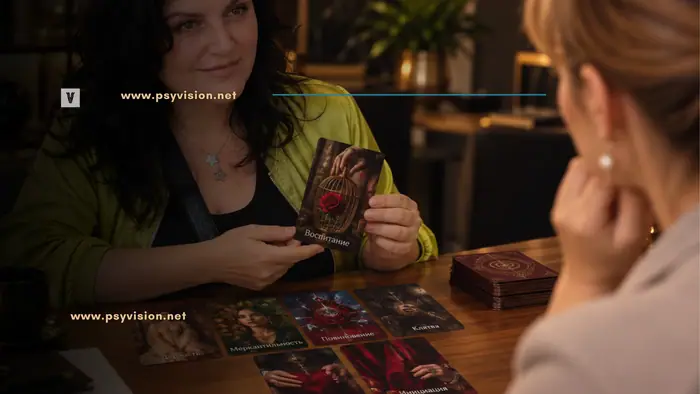
  • With a psychologist. A specialist takes the deck as a ready frame for a session: the stimulus, the questions, the search for the echo in the body, the ending. Their own techniques stay their own.
  • Over the long run. 21 cards × 21 stories × 21 tales — 9,261 combinations. Some time later the same card unfolds differently, because you answer differently.
Programmes

Programmes on “Metaphorical associative cards”

All programmes →

Programme

Tarot without fortune-telling.
A journey to the Self.

7 months
Starting soonCourse

Online programme “Tarot Without Fortune-Telling. A Journey to the Self”

Seven months with the archetypes of Tarot, inspired by Hajo Banzhaf. 22 initiations, from the Magician to the Fool. Integrating the Shadow and the Self through Jung’s psychology.

Starts: 11 January 2027$640

Programme

Symbolon cards.
Initiation by symbol.

12 months
EnrollingCourse

Online programme “Symbolon Cards. Initiation by Symbol”

A twelve-month programme on Symbolon cards. A synthesis of astrology, depth psychology and energy work. An original programme by a practising psychologist. Discover the secrets of your inner world.

Date to be confirmed$950
Articles

Related articles

All articles →
✦
4 February 2025 · Metaphorical associative cards

Working with images. Methods of self-development and inner work

Each of us can become the creator of our own reality. By using the power of visualisation, you can not only change how you perceive the world but also actively shape how it unfolds. Open new horizons, experiment with images and watch how, day by day, your life is transformed and your inner world fills with harmony and inspiration.

Read7 min
5 January 2022 · Metaphorical associative cards

Psychology and esotericism. From the psychic to the spiritual

Tarot psychology, astropsychology, rune psychology, numerology, metaphorical associative cards and other systems all begin with a basic knowledge of psychology! Psychology is the foundation for studying and using any mantic system effectively. It makes no difference whether you…

Read7 min
10 March 2021 · Psychology for everyday life

Psychology. Personal boundaries in work with metaphorical associative cards — MAC

At today’s pace of life, personal boundaries are a topic everyone keeps hearing about. Whenever people interact, their boundaries meet in one way or another. So what are boundaries, and why does it matter so much to build them? Blurred boundaries are a tendency to get drawn into other people’s moods, attempts to control…

Read3 min
Contact us

Write to us

Pick the way that suits you — a messenger, email or the form.

Tools

Other tools

All tools →
live
Web app

Cosmogram

A natal chart in the browser: date, time and place of birth give you a finished cosmogram with tables of planets, houses and aspects. Everything is calculated on your own device; no sign-in and no payment.

Browser

Reach us the way you find convenient!

Pick a messenger, call us or write — we answer during working hours.

Online · we reply from 10:00 to 20:00

Tool: The Girl in the Black Funnel