 Анна Шиман
Draft translation. This text was translated automatically and has not been proofread yet — if something reads oddly, it does.
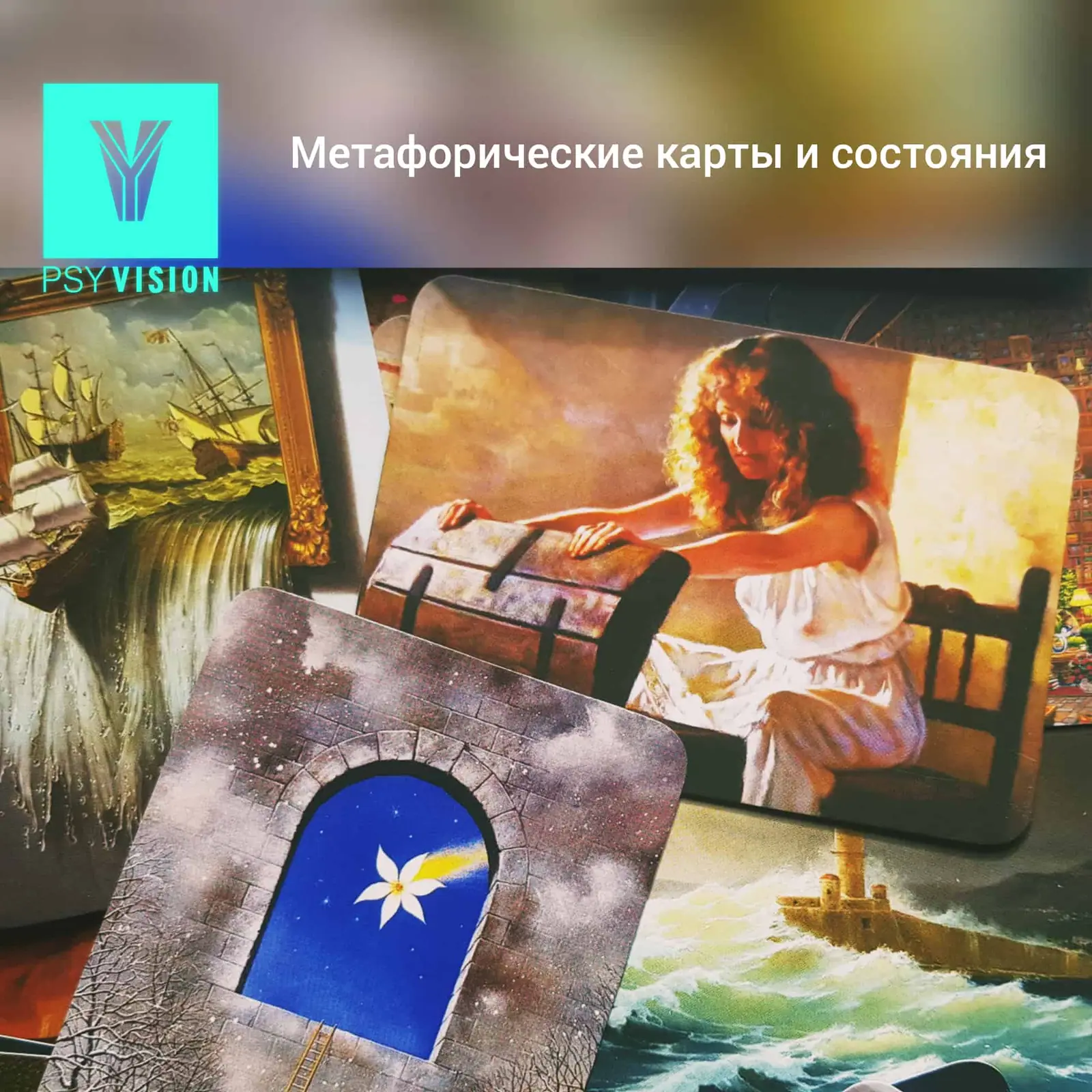
Metaphorical associative cards as a tool in a psychologist’s work.
Anyone who has even once encountered metaphorical cards at work, in exploring the subconscious, in dealing with everyday questions or in resolving personal issues, is guaranteed to fall in love for ever with the practical possibilities of this wonderful tool!
The psyche consists of the conscious and the subconscious, of the outer and the inner world.
We could say that the conscious part “knows” what it can explain, what is open and accessible, and can give it meaning.
The unconscious part also “knows” what a person needs, and holds their hidden drives, needs, desires, conflicts and resources valuable for life. Yet a person often has all this wealth and does not use it. Sometimes we want one thing, while the unconscious attracts something completely different into our lives.
The world of the unconscious speaks to us through bodily sensations, states, emotions, experiences and moods.
To understand ourselves we need tools that will bring unconscious content into the realm of consciousness.
Then the meaning becomes clear, and the person says:
“Now I see! I get it! I know what to do!”
Understanding makes it possible to change your behaviour, see your true desires and resolve the conflict between parts of your personality. It brings confidence and stability.
A lack of understanding is often accompanied by states and feelings such as anxiety, fear, longing, despair, helplessness, numbness, apathy, laziness, self-sabotage, guilt, shame and others.
To explore and change these states, we turn inwards with the help of metaphorical cards.
Through the images that arise from contact with the picture on a card, and through analysing them together with a psychologist, you come to understand what you really want, get to know your needs, relieve stress and work with different states, improving your life.
By engaging the emotional and sensory way of perceiving, a person gains access to the world of inner meanings.
Metaphorical cards are an indispensable helper in this work.
When we learn to pay attention to our sensations, states and desires, the world around us gains depth and brightness. Interest in life grows, and it becomes possible to want things and to get what you want. Satisfaction with yourself, with others, with everyday life and with life as a whole increases.
What could a person want more than to meet themselves?
We often hide from ourselves the aspects of our personality that we perceive as alien. We fear these qualities when they show up in others and do not want to see them in our lives.
Yet a person feels the greatest satisfaction at the moment when they manage to restore their wholeness and say to the rejected part of themselves:
“Hello! I see you! You exist! And although I’m still afraid, you are part of me!”
Thanks to such a meeting, the world changes, sometimes beyond recognition.
Metaphorical cards, together with an experienced psychologist, will help you understand yourself, resolve inner conflicts, change your moods, adjust your states, deal with negative feelings, find inner support and gain self-confidence.
Can you imagine that one small picture could change your outlook on the world?
Make your world lighter and brighter? Make it sound?
Tell you without words what really matters?